Catégories
Indéfinition

zuanka

repère(s) :Japon

Before a fabric can be woven, it must first be conceived. The zuanka 図案家, or pattern designer, occupies a unique position in the Japanese textile industry. Their work consists of creating designs that are then translated into threads, colors, and weaving structures. They operate at the intersection of art and industry. The designer must understand the technical constraints of the craft while remaining attentive to changing tastes. Their creations respond to commercial demands but also contribute to the invention of new aesthetics. In certain periods, the best designers exert an influence comparable to that of contemporary fashion designers. Their work reveals the importance of imagination in an activity often perceived as purely artisanal.Lire la suitezuanka

Vous pouvez compléter, modifier, améliorer cette indéfinition ou en proposer une autre au regard de vos savoirs, langages, pratiques, histoire… qu’elle soit formulée sur un mode scientifique, culturel, poétique… contact@21dialogues21.org
Catégories
Indéfinition

obi

repère(s) :Japon

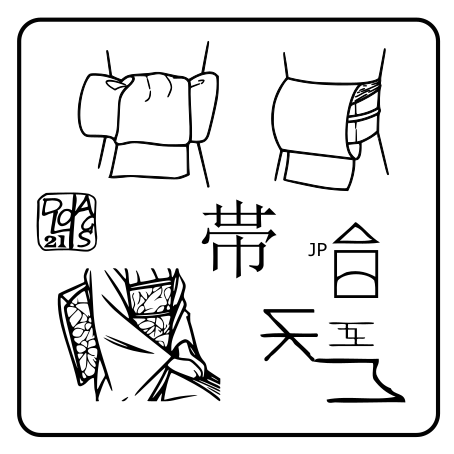
The obi 帯 is one of the most sophisticated forms of the sash. Its significance extends far beyond the realm of clothing. Over the centuries, its width, texture, color, and method of tying have signified age, social status, marital status, or even the ceremonial occasion. The knot at the back constitutes a true visual language. The obi is also a space for aesthetic invention where patterns inspired by nature, poetry, the seasons, or beliefs are displayed. It represents an interesting paradox: while it is a constraining element that holds the garment in place, it is also one of the primary vehicles for creativity. In the global history of costume, few objects have concentrated so many social and artistic meanings into a single strip of fabric. Its study opens up themes of weaving, the body, social representation, and the transmission of craftsmanship.Lire la suiteobi

Vous pouvez compléter, modifier, améliorer cette indéfinition ou en proposer une autre au regard de vos savoirs, langages, pratiques, histoire… qu’elle soit formulée sur un mode scientifique, culturel, poétique… contact@21dialogues21.org
Catégories
Indéfinition

nishijin-ori

repère(s) :JaponKyoto

Nishijin-ori 西陣織 is one of Japan’s most prestigious textile traditions. Developed in a historic district of Kyoto, it is distinguished by the richness of its patterns, the complexity of its weaves, and the use of particularly refined threads. For centuries, these fabrics have been associated with ceremonial garments, religious objects, and prestigious accessories. Nishijin-ori artisans often draw on skills passed down through several generations. Each fabric is the result of collaboration between designers, dyers, yarn preparers, and weavers. This collaborative process underscores that great artisanal traditions are rarely the work of a single individual. Nishijin-ori also stands as a remarkable example of the dialogue between conservation and innovation. Traditional techniques continue to be practiced while incorporating new materials and new uses.Lire la suitenishijin-ori

Vous pouvez compléter, modifier, améliorer cette indéfinition ou en proposer une autre au regard de vos savoirs, langages, pratiques, histoire… qu’elle soit formulée sur un mode scientifique, culturel, poétique… contact@21dialogues21.org
Catégories
Indéfinition

kasuri

repère(s) :Japon

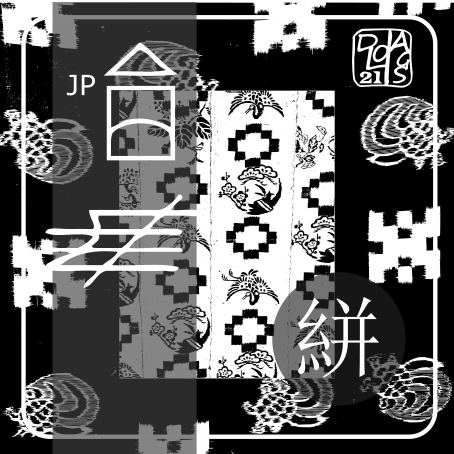
Kasuri 絣 refers to a family of Japanese textiles characterized by slightly blurred, almost vibrant patterns. This effect is not the result of printing or painting applied to the finished fabric, but of work carried out even before weaving begins. Certain sections of the threads are protected during dyeing, so that the designs emerge when the threads are finally assembled on the loom. This technique requires remarkable foresight: the artisan must envision the pattern before the fabric actually exists. Kasuri thus belongs to a long tradition in which textile creation relies as much on planning as on execution. The slight misalignments between the threads are part of its beauty. Where modern industry often seeks geometric perfection, kasuri values a living precision that leaves room for the slightest variation. This aesthetic aligns with certain Japanese conceptions of controlled imperfection. The fabric becomes a space where calculation, chance, and sensitivity meet. Kasuri reminds us that textiles are also an art of time, since their design emerges gradually as the work progresses.Lire la suitekasuri

Vous pouvez compléter, modifier, améliorer cette indéfinition ou en proposer une autre au regard de vos savoirs, langages, pratiques, histoire… qu’elle soit formulée sur un mode scientifique, culturel, poétique… contact@21dialogues21.org

Catégories
Indéfinition

jinrikisha

repère(s) :Japon

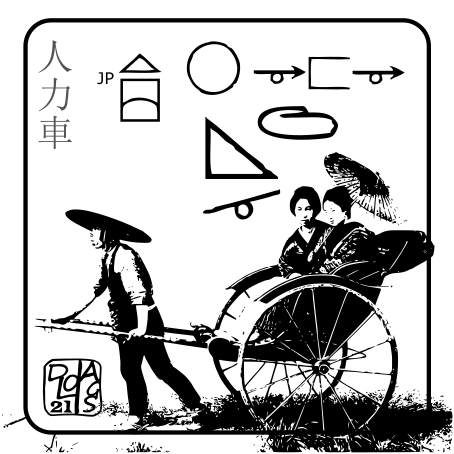
The Japanese word jinrikisha 人力車 literally means “human-powered vehicle.” First appearing in 19th-century Japan, this invention combines two major traditions: human traction and the modern lightweight wheel. The vehicle is pulled or pushed by a person while one or more passengers sit in the back. Its development coincided with the rapid modernization of Japanese cities during the Meiji era. The jinrikisha offered relatively fast mobility in urban areas where motorized infrastructure was still limited. It quickly became a symbol of Asian urban life before spreading to other parts of the world. Its history also raises social questions. Passenger comfort depends directly on the driver’s effort. The vehicle thus reveals economic hierarchies and changes in the nature of work within industrializing societies. Straddling tradition and modernity, the jinrikisha occupies a unique place in the global history of mobility.Lire la suitejinrikisha

Vous pouvez compléter, modifier, améliorer cette indéfinition ou en proposer une autre au regard de vos savoirs, langages, pratiques, histoire… qu’elle soit formulée sur un mode scientifique, culturel, poétique… contact@21dialogues21.org

Catégories
Articles

Tanaka Shōzō

repère(s) :Japon

Tanaka Shōzō (田中正造, 1841–1913) est un homme politique et militant japonais, souvent considéré comme le premier écologiste du Japon moderne. Député durant l’ère Meiji, il est célèbre pour son combat contre la pollution provoquée par la mine de cuivre d’Ashio, symbole de la tension entre industrialisation et justice environnementale. Fils d’un chef de village, Tanaka devient lui-même chef de sa…Lire la suiteTanaka Shōzō